
Patient Resource® Cancer Guide
Linette Atwood, CEO/Publisher, Patient Resource Publishing understands cancer at all levels and felt she could put her knowledge and experience to your advantage. Her father died of stomach cancer at 62, her husband died of leukemia at 50, her sister died of breast cancer at 49, and Linette was diagnosed and beat breast cancer.
Their trusted patient education publications are the most comprehensive, nationally distributed cancer resources in the United States. They distribute, free of charge, more than 500,000 copies of their guides annually, primarily through physician offices, cancer treatment facilities and patient advocacy organizations. Continue Reading…
What should I eat? What shouldn’t I eat?
These questions take on new urgency after a cancer diagnosis. At the Bloch Cancer Hotline, we often hear from people who want to change their diet during and after cancer treatments. Many cancer organizations offer guidance, but you should also consider a consultation with Continue Reading…
PDQ From NCI – Physician Data Query
PDQ is an online database developed and maintained by the National Cancer Institute. Designed to make the most current, credible, and accurate cancer information available to health professionals and the public Continue Reading…
ASCO’s Cancer.Net en Español
El sitio Web de la Sociedad Estadounidense de Oncología Clínica (American Society of Clinical Oncology, en inglés). En este sitio Web puede buscar información para ayudar a los pacientes y las familias a tomar decisiones informadas sobre el cuidado de la salud Continue Reading…
ASCO-The American Society of Clinical Oncologist provides clear, accurate information on cancer in English and Spanish.
ASCO, The American Society of Clinical Oncology has an excellent website that provides information Continue Reading…
Acupuncture and Cancer
Cancer Forums conducted by major cancer treatment hospitals can be an excellent way to get your questions answered by an expert. We receive many questions regarding integrative cancer care during treatment so this forum caught our attention. Continue Reading…
Clinical trial terminology explained
New from Johns Hopkins Health Alerts–The National Cancer Institute estimates that between 5% and 8% of cancer patients participate in clinical trials. Why is the number so low? Part of the problem is that many patients believe that all clinical trials include a placebo (an inactive treatment with no known therapeutic value) and treat participants like “guinea pigs”–neither of which is true. To help clear up the confusion, this Johns Hopkins Health Alert explains clinical trial terminology, including randomization, placebo, and blinding. Click on the link to read the complete report: http://www.johnshopkinshealthalerts.com/alerts/prostate_disorders/JohnsHopkinsHealthAlertProstateDisorders_3263-1.html?ET=johnshopkins_blog:e34955:607412a:&st=email&st=email&s=EPH_091217_013
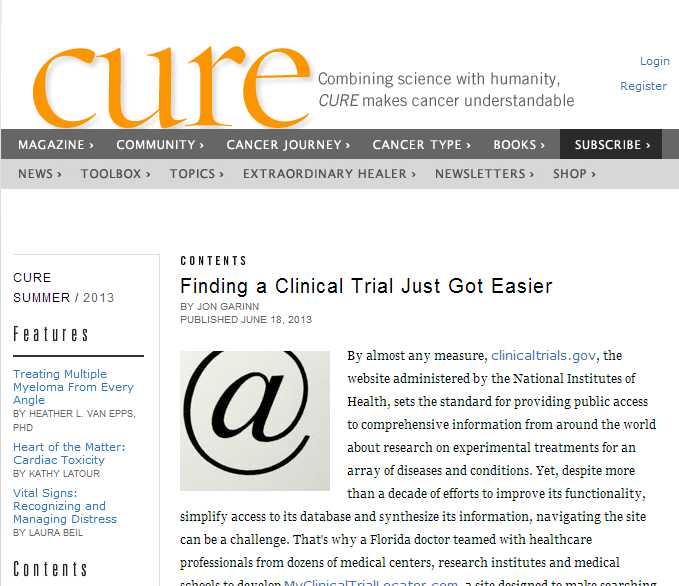
National Institutes of Health make it easier to find a clinical trial.
Press release: Tuesday, November 10, 2009 11:07 AM
NIH ANNOUNCES FIRST NATIONAL RESEARCH STUDY RECRUITMENT REGISTRY Nationwide Registry to “Match” Volunteers with Researchers Continue Reading…
Positive Mental Attitude Walk Plaques
POSITIVE MENTAL ATTITUDE WALK
- Cancer is the most curable of all chronic diseases.
- There are treatments for every type of cancer. Continue Reading…